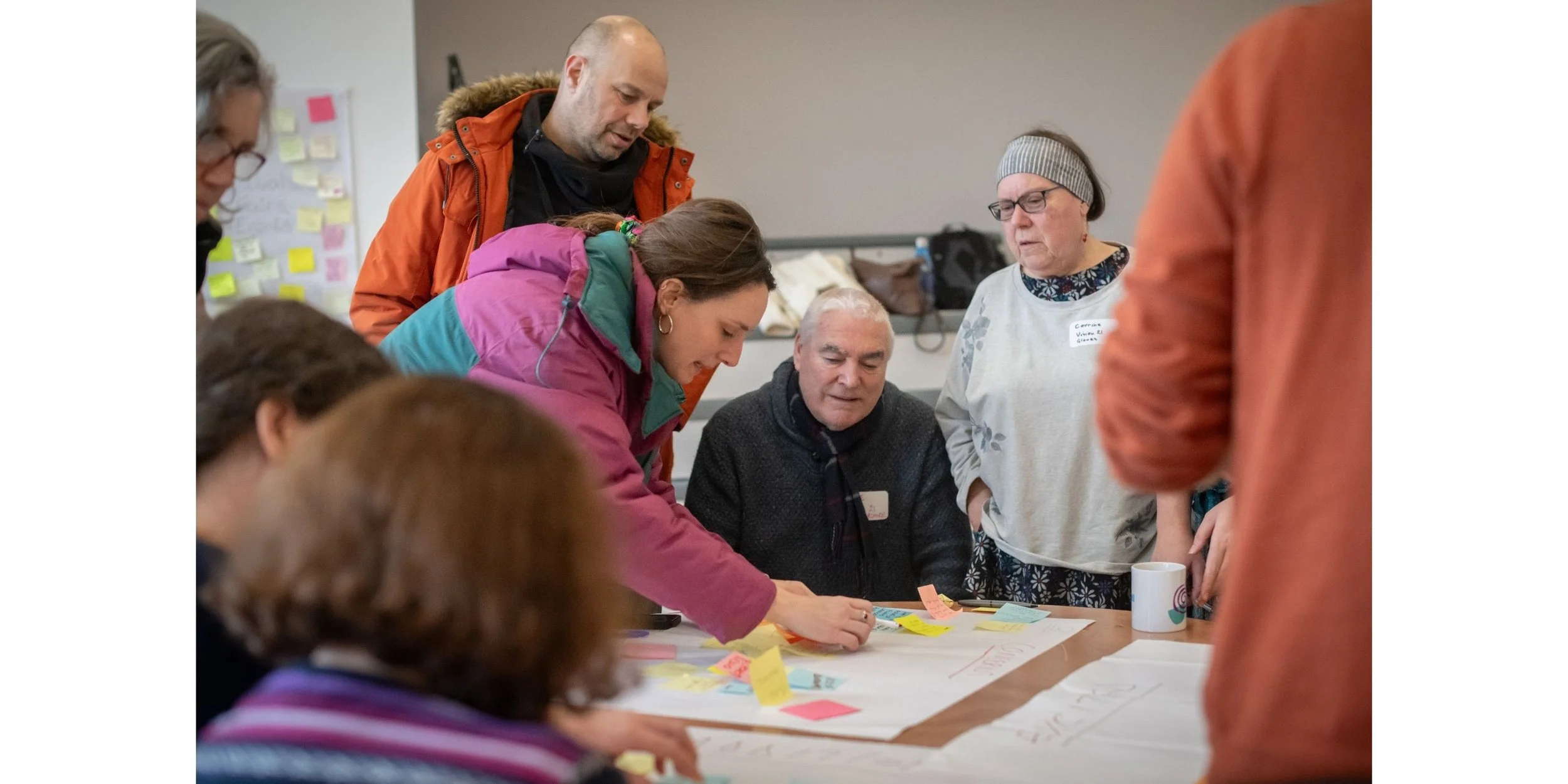
Photo credit: Mouse About Town
● How We Work
We work in ways that are relational, adaptive and rooted in place.
We don’t arrive with fixed programmes or predefined solutions.
Instead, we start by paying attention, to what is already happening, who is already here, and what is trying to emerge.
From there, we shape the work with others, responding to each place as it is, rather than applying a model from the outside.
● Our methods
Our work is underpinned by innovative methodologies we’re constantly testing:
-
Our work focuses on growing the conditions that allow places to organise, collaborate and shape their own future.
Over time, these conditions form what we call living infrastructure — the relational, cultural and systemic foundations that make long-term, community-led change possible.
Living infrastructure includes:
Relational infrastructure: Trust, relationships and collaboration between people, organisations and the living world.
Cultural infrastructure: Shared stories, identity, creativity and imagination that shape how people see their place and what they believe is possible.
Systemic infrastructure: The skills, knowledge, resources and structures that allow communities to organise, steward assets and influence the systems that affect their lives.
Across our work, we intentionally focus on strengthening the conditions that help this infrastructure grow, including:
local leadership
strong relationships and trust
shared identity and stories
a sense of agency and participation
connection to land and place
community spaces and assets
practical skills and capacity
collective imagination
joy, culture and celebration
By growing these conditions, places become more able to organise, respond to change and shape their own future.
-
We support Living Places through four interconnected strands of work.
Living Spaces & Places: Supporting towns and villages to come together and shape their local future. Learn more.
Living Systems & Flows: Helping communities understand and reshape how land, money, power and resources move through their place. Learn more.
Living Culture & Narratives: Strengthening identity, belonging and imagination through storytelling, creativity and shared skills. Learn more.
Living Networks & Movements: Connecting communities, organisers and institutions so learning and support can move between places. Learn more.
Together, these strands help communities organise, collaborate and act.
-
The challenges communities face today are deeply interconnected.
Climate change, economic inequality and social disconnection cannot be solved in isolation.
We believe a different future is possible.
A future where:
communities have the power to shape their own future
local economies work for the people who live there
ecosystems are cared for and restored
culture, creativity and belonging are part of everyday life
Restoring social justice and equity and lively, hopeful local conversations.
By helping Living Places grow and connect, we hope to contribute to a wider movement of communities shaping regenerative and equitable futures together.
● Our Values
Our work is as practical as it is big picture thinking; rooted in lived realities, making, doing, and creating together.
Purposefully practical
We counteract bigness and scale by weaving small, place-based systems of care; rooted in long-term relationships.
Relationally rooted
We believe tomorrow’s thriving communities rely on today’s brave experiments and bold ideas.
Creatively pioneering
We unlock resilience, mutualism, togetherness and transformative potential through deep connection, trust and collaborative action .
Radically collaborative
We take bold steps to address deep inequities present today to bring into reality post-capitalist futures, rooted in justice, care, compassion and liberation.
Boldy liberatory
● Holding different lenses up to our work
Systems change: We work at the level of conditions, relationships and structures that shape how a place functions, rather than focusing only on individual projects.
Complexity: We don’t treat places as problems to solve, but as living systems to work within, where change emerges through action and learning.
Community development: We move away from models that act on communities, towards approaches where communities lead and shape their own development.
Bioregional: We pay attention to the natural boundaries and systems that shape a place, such as rivers, land and ecology, not just administrative lines.
Regenerative: We are working towards ways of living and organising that restore and strengthen the health of people, communities and ecosystems over time.